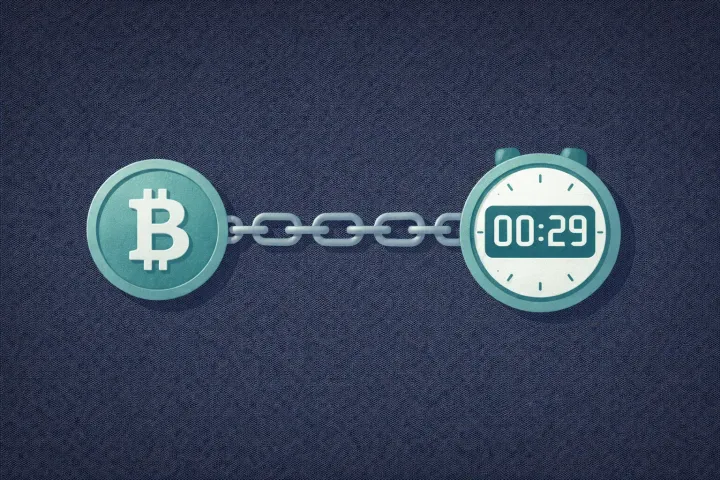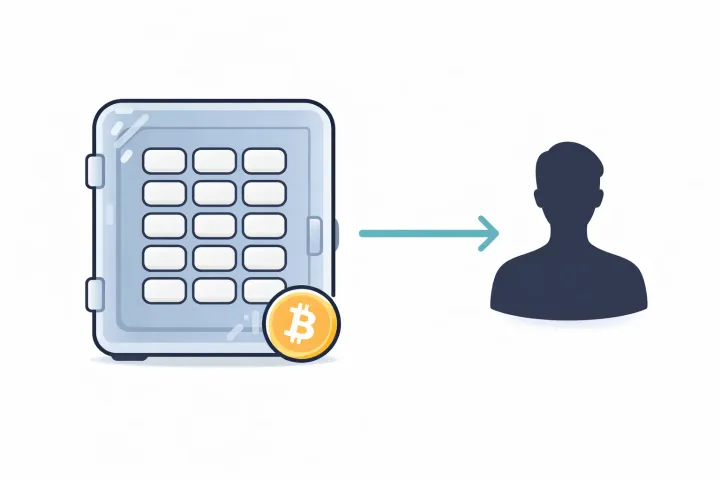
Crypto has no forgot-password button. If your family doesn’t have your seed phrases, exchange logins, and wallet passwords, those assets are gone permanently when you can’t hand them over. But sharing them today means giving up control today.
You wouldn’t hand your family the keys to your house and say “just hold these, in case something happens.” You’d want a system where they can get in when they need to, but not before. Where you stay in control until the moment you can’t be.
Crypto works the same way, except the stakes are worse. Lose your house keys and a locksmith can help. Lose access to a crypto wallet and there’s no one to call. No bank. No customer support. No recovery process. The coins just sit there forever.
So you need a plan. Not one that hands your family full control right now, a plan that bridges the gap between “I’m in charge of my own keys” and “my family can access these if I’m not around.”
Why crypto inheritance is different
Traditional financial accounts have safety nets. Your bank knows who you are. Probate courts can compel institutions to release funds. Slow, but there’s a path.
Crypto has none of that. Private keys and seed phrases are bearer instruments, whoever holds them controls the funds. No identity layer, no court order that unlocks a blockchain, no support desk. Chainalysis estimates roughly 20% of all Bitcoin (around 3.7 million BTC) sits in wallets that are lost or permanently inaccessible.
When QuadrigaCX founder Gerald Cotten died in 2018, roughly $190 million in customer funds became unreachable because he was the only person with the keys. That was a corporate failure, but the same problem hits families every day on a smaller scale. A few thousand in a Coinbase account. Half a Bitcoin on a Ledger in a desk drawer.
Some estate planners now specifically ask about digital assets. The legal system moves slowly, though, and crypto doesn’t wait. Having a solid crypto inheritance plan in place before any of that becomes urgent is the whole point.
Crypto has no forgot-password. Plan the bridge your family crosses when you can't hand them the keys.
What not to do
Before getting into solutions: some approaches seem convenient but create real risk.
Don’t text your seed phrase. SMS is stored in plaintext on carrier servers, your phone, and the recipient’s phone. Same for WhatsApp, Telegram, or any messaging app where data gets backed up to iCloud or synced.
Don’t email it. Email sits in plaintext on provider servers, often indefinitely. If your family member’s account gets phished three years from now, your seed phrase is right there in their inbox.
Don’t put it in a shared Google Doc or Apple Note. Plaintext on corporate servers. A single compromised account exposes everything.
Don’t assume your family will figure it out. Most non-crypto-native people don’t know the difference between an exchange and a self-custody wallet. They won’t know to look for a hardware wallet or what a seed phrase even is.
Don’t rely on a single point of failure. One piece of paper in one safe. One person who knows everything. Single-point-of-failure setups eventually fail.
Options for sharing crypto access
There’s a spectrum, from deeply technical to dead simple. The right choice depends on how much you hold, how technical your family is, and how much operational overhead you’re willing to maintain.
A dedicated sharing tool like AbsentKey
Instead of adapting a password manager or multisig wallet to solve the inheritance problem, you can use something designed from the start for conditional, time-delayed access.
AbsentKey is built around this use case. Your family doesn’t have passive access to anything. They request access when they need it. You get notified, approve instantly, deny, or don’t respond. If you can’t respond, the per-person timer you set runs out and they get access automatically.
Multisig wallets
Multisig wallets require more than one private key to authorize a transaction. A 2-of-3 setup means any two of three keyholders can move funds. For large holdings, this is the strongest approach. Unchained Capital and Gnosis Safe both offer solid implementations.
The downsides: real operational complexity, your co-signers need to understand key management, and multisig only covers on-chain assets. It doesn’t help with exchange accounts, DeFi logins, authenticator recovery, or any other credentials your family might need.
Shamir’s Secret Sharing
SSS splits a secret into multiple shares where only a threshold can reconstruct the original. Inheriti built a product around this using blockchain-based storage. Trezor supports it natively for seed phrase backups.
Technically clever, but operationally heavy. If your spouse needs to recover your Bitcoin after an emergency, can they coordinate three out of five shareholders under time pressure? For most families, that’s asking too much.
Hardware wallet with instructions in a safe
Put your hardware wallet in a safe with the PIN, seed phrase, and step-by-step instructions in a sealed envelope. This works for a moment in time, but it goes stale fast. You add a new wallet, change a PIN, open a new exchange account. Whoever opens the safe also gets full access immediately, with no waiting period and no notification to you.
Password manager shared vault
Storing seed phrases in a password manager and sharing the vault beats email or Google Docs. But sharing a vault means your family has access right now. Emergency access features add some time-delay capability, though they’re limited: NordPass locks you into 7 days, Bitwarden requires both people to have premium accounts, and 1Password doesn’t offer in-app emergency access at all.
A seed phrase isn’t a Netflix password. The consequences of premature access are permanent. A crypto dead man’s switch with a request-based model solves this without the false-trigger risk of check-in systems.
How it works for crypto
The actual setup for crypto looks like this.
Store everything in one place. Seed phrases, exchange logins, hardware wallet PINs, 2FA backup codes, authenticator recovery keys, DeFi protocol instructions. You can store text secrets and files.
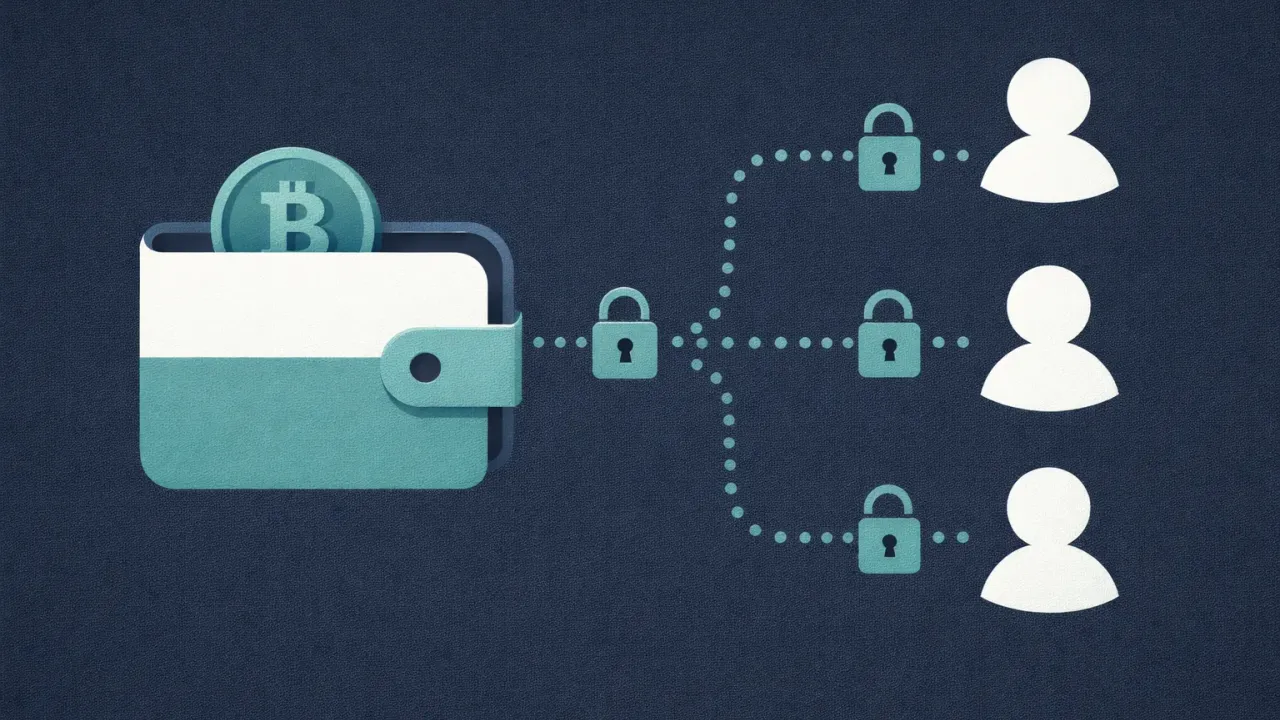
Assign secrets to specific people. Your spouse might get access to everything. A sibling might only get exchange account credentials. Your parents might get a general overview document but not the actual seed phrases.
Set waiting times per person. This is the part that matters most for crypto. Your spouse might have a 7-day timer. Your parents 30 days. A business partner who manages shared protocol positions might get 3 days.
# Per-person waiting times, calibrated by relationship
spouse           → 7   days   # trusted, urgent path
sibling          → 30  days   # exchange logins only
cofounder        → 3   days   # shared treasury access
parent           → 90  days   # overview doc, not seeds
technical_friend → 180 days   # cold storage seed
End-to-end encrypted. AbsentKey uses XSalsa20-Poly1305 encryption with X25519 key exchange. Secrets are encrypted on your device before upload. The server never sees plaintext secrets. The mobile client is source-available on GitHub.
Receiving is free. Your family members don’t need a paid account to be recipients. They download the app, accept your invitation, and they’re set. Only the person creating and sharing secrets needs Premium ($1.99/month or $19.99/year). Asking your parents to maintain a paid subscription on a service they’ll hopefully never need is a hard sell.
What to include in your crypto package
If you’re setting this up, here’s what to actually put in it. Think of it as a complete handoff kit. Our guide on seed phrase inheritance covers this in even more detail.
Seed phrases for every self-custody wallet. All 24 words, in order. If you use a passphrase (the “25th word”), include that separately and make it clear it’s required. Label each phrase with which wallet it belongs to and roughly what’s in it.
Exchange account credentials. Username, password, and the email address associated with each exchange account. Include approximate values so your family knows which accounts to prioritize.
Hardware wallet PINs and locations. Your Ledger PIN, Trezor PIN, and the physical location of each device. Include the model name, recovery differs between devices.
2FA recovery codes. If you use Google Authenticator, Authy, or a YubiKey for exchange 2FA, your family needs the backup codes. Without these, the password alone won’t get them in.
A plain-language overview of your holdings. Write it for someone who’s smart but not crypto-native: “I have approximately 0.5 BTC in a Ledger in my desk drawer. Seed phrase is stored as a separate secret in this app. About $3,000 in ETH on Coinbase, login below…” This overview is the map. Without it, your family is searching blind.
DeFi positions and protocol details. If you have funds in DeFi (Aave, Uniswap, Lido, Yearn), document the protocol name, blockchain, wallet address, and basic withdrawal instructions. DeFi positions can lose value quickly if unmanaged.
Instructions for what to do first. A short “if you’re reading this” section: “First, secure exchange accounts by enabling withdrawal locks. Then move hardware wallet funds to a new wallet you control. Don’t rush the DeFi positions unless something is actively losing money.”
FAQ
Can’t I just set up beneficiaries on my exchange accounts?
Some exchanges allow beneficiary designations now. Coinbase lets you name a beneficiary who can request access with a death certificate. But that only covers funds on that specific exchange, takes weeks or months to process, and doesn’t touch self-custody wallets or DeFi positions. Worth doing as one layer, not a complete solution on its own.
What about crypto-specific inheritance services like Casa or Unchained?
Both offer collaborative custody where multiple keys are distributed across parties. Solid for Bitcoin holders with significant positions ($100K+), but expensive. Casa starts at $248/year. For most people with diversified holdings across multiple chains, exchanges, and DeFi protocols, they solve only part of the problem. They’re Bitcoin-focused and key-focused. The credentials, instructions, and context your family needs go well beyond private keys.
Is it safe to store seed phrases in any app?
Depends entirely on the encryption model. A seed phrase in a note-taking app? Serious risk. A seed phrase in a zero-knowledge, end-to-end encrypted vault where even the provider can’t read it? That’s safer than paper in a drawer that could be found, photographed, or destroyed in a fire. The questions to ask: is the encryption end-to-end (client-side, not server-side)? Is the implementation auditable? Can the provider access your data if subpoenaed? If that last answer is “no, mathematically impossible,” the encryption is doing its job.
The quiet truth
The uncomfortable truth is that most people in crypto have no inheritance plan at all. They’ve thought about hardware wallets and cold storage and seed phrase backups, but not about what happens when they’re the single point of failure and they’re no longer available.
Setting this up takes about fifteen minutes. Putting it off is how fortunes end up locked in wallets forever.
Download AbsentKey and start with your most valuable holdings. Your family won’t need to understand multisig or Shamir’s Secret Sharing. They’ll just need to open the app and request access.