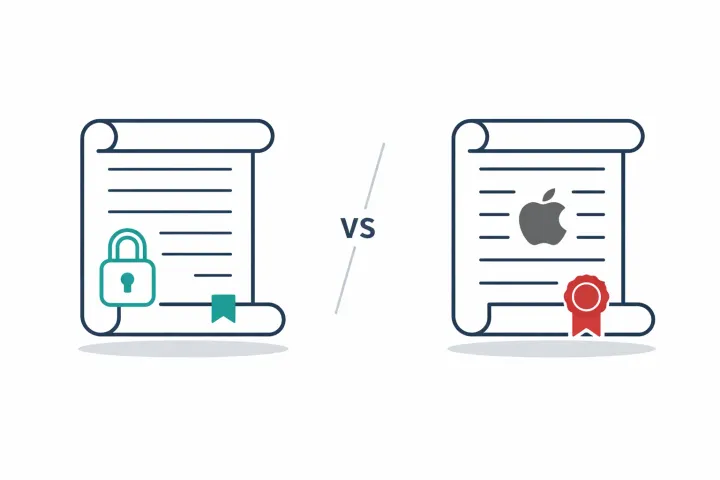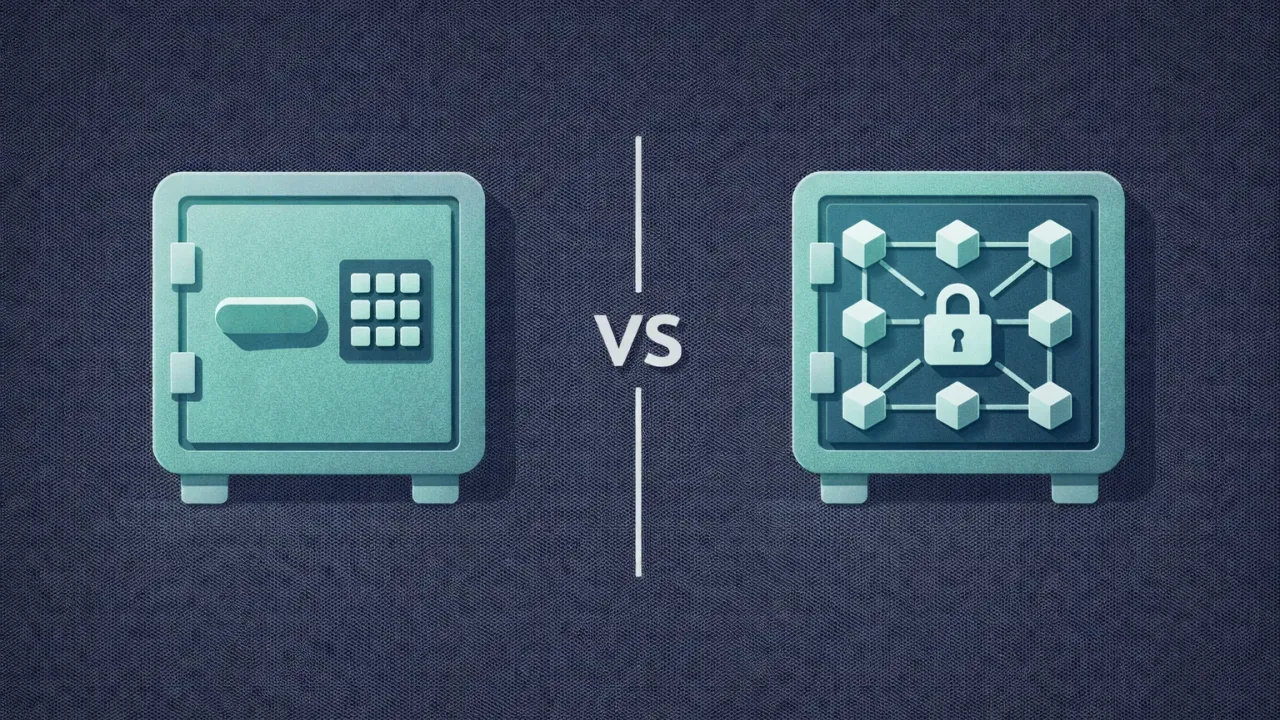
Inheriti and AbsentKey solve the same problem with totally different technology. Inheriti is a blockchain-based protocol that fragments and distributes secrets on-chain using Shamir’s Secret Sharing. AbsentKey is a centralized encrypted vault with timer-based access. If you live in the crypto ecosystem, Inheriti might be exactly what you need. If your recipients have never connected a wallet, AbsentKey is the simpler path.
Two completely different architectures
Inheriti and AbsentKey both deal with the same core problem: making sure your sensitive information reaches the right people when you can’t hand it over yourself. It’s the emergency access challenge. How they solve it couldn’t be more different.
Inheriti puts your data on the blockchain. It fragments your secrets using Shamir’s Secret Sharing, distributes those fragments across a decentralized network, and uses smart contracts to govern when and how the pieces get reassembled. The protocol runs on multiple chains: VeChain, Ethereum, Optimism, Polygon, BNB Chain, and Base. It’s patented (the first patented backup and inheritance protocol, which is notable), and there’s a hardware cold storage device called SafeKey.
AbsentKey stores your secrets in a centralized encrypted vault. You create a secret, assign it to a recipient, set a waiting time, and the system handles access based on requests and timers. Encryption is end-to-end, the server never sees plaintext secrets, and the mobile client is source-available. No blockchain, no tokens, no smart contracts.
Neither architecture is objectively better. They’re different bets on what matters most: decentralization and trustlessness versus simplicity and accessibility. Your pick depends on your threat model, your technical comfort, and who your recipients are.
Quick comparison
# architecture absentkey → zero-knowledge e2e, centralized infra inheriti → shamir’s secret sharing on-chain (multi-chain)
# trigger absentkey → recipient request, no check-ins inheriti → dead man switch, check-in based
# recipient overhead absentkey → install app, tap accept inheriti → wallet + sha tokens + chain selection
# pricing absentkey → $1.99/mo or $19.99/yr (receiving free) inheriti → one-time + token fees
What Inheriti does
Worth understanding what Inheriti has actually built before comparing the two.
The core is Shamir’s Secret Sharing, a cryptographic technique that splits a secret into multiple fragments where only a defined threshold can reconstruct the original. Split a secret into 5 shares with a threshold of 3, and any 3 shares recover the secret. Two shares reveal nothing. It’s mathematically proven, not a marketing claim. The technique dates back to 1979 and is well-understood.
What Inheriti does differently is put this process on-chain. Fragments are stored across multiple networks, and smart contracts govern the reassembly rules. No single company holds your data. If Inheriti the company disappeared tomorrow, the fragments would still exist on the blockchain, and the protocol for reassembling them would still be encoded in the smart contracts. That’s a form of resilience that centralized services can’t match.
The Dead Man Switch activation works through check-ins. You periodically confirm you’re still active. Stop responding, and the Merge Authority system kicks in designated people can initiate the process of recombining fragments and recovering your secrets.
The SafeKey hardware device adds a physical, air-gapped storage option alongside on-chain storage.
Inheriti supports a broad range of data types: plain text, private keys, seed phrases, recovery codes, API keys, PINs, login credentials, and payment card information. Inheriti Business is on the horizon too, expanding into enterprise use cases.
Pricing is one-time payments with modular options, appealing if you don’t want recurring subscriptions. The SHA token is required for blockchain storage fees, though, so you’re interacting with a token economy even if the base product has a one-time cost.
What AbsentKey does
AbsentKey takes a deliberately simpler approach.
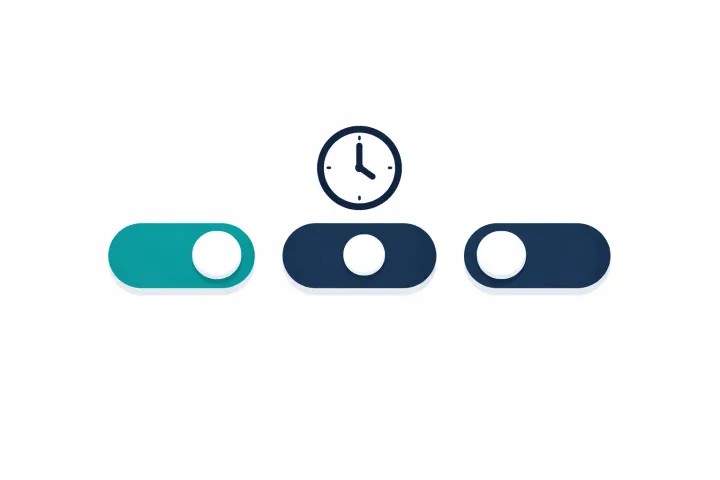
You download the app on iOS or Android. Create a secret text (passwords, seed phrases, PINs, notes) or a file (PDFs, images, documents, anything). Add one or more recipients. Set a waiting time for each, anywhere from 1 day to 365 days.
Decentralization promises your future self. Simplicity promises the people holding the phone.
When a recipient needs access, they request it through the app. You get a push notification. You can approve immediately, deny it, or do nothing. If you don’t respond before the waiting time expires, the recipient gets access automatically.
No check-ins. AbsentKey doesn’t ping you daily or weekly to prove you’re alive. The system sits quietly until someone actively requests access. You can share passwords without giving access until the moment they’re needed. If nobody requests, nothing happens your secrets stay encrypted indefinitely.
The encryption uses XSalsa20-Poly1305 for symmetric encryption, X25519 for key exchange, and HKDF-SHA256 for key derivation. It’s zero-knowledge: AbsentKey’s servers store encrypted secrets and encrypted content keys. Stolen server data alone does not provide the private keys needed to read your secrets.
Receiving is always free. Your recipients never pay anything. They download the app, accept the share, done. The person creating and sharing secrets pays $1.99/month or $19.99/year.
Key differences
Blockchain vs centralized. The fundamental split. Inheriti distributes your data across decentralized networks where no single entity controls it. AbsentKey stores encrypted data on centralized servers (Cloudflare infrastructure). Both carry different trust assumptions. With Inheriti, you’re trusting the blockchain and the smart contract code. With AbsentKey, you’re trusting the encryption implementation and the server infrastructure. If “no company holds my data” is your primary requirement, Inheriti wins that category outright.
Technical complexity. Inheriti requires you to interact with blockchain wallets, understand which chain you’re on, hold SHA tokens for fees, and navigate concepts like Merge Authority and secret sharing thresholds. None of that is unreasonable for someone already in the crypto ecosystem, but it’s a real barrier for people outside it. AbsentKey’s learning curve is closer to a messaging app: install, create a secret, add a person, set a time. Recipients face an even lower bar since they just download a free app and tap a button.
Inheriti expects your heirs to manage wallets, gas, and chain selection. AbsentKey expects them to install an app and tap accept. Match the tool to the people who’ll actually use it.
Mobile vs browser. AbsentKey is mobile-first with native iOS and Android apps. Inheriti is browser-based with no native mobile app. In practice, this matters. Mobile apps support push notifications for access requests, biometric authentication, and the kind of quick interactions that make the system usable day-to-day. Browser-based access works on any device with a browser (no app store dependency), but it’s a different experience.
Check-in vs request-based. Inheriti’s Dead Man Switch requires periodic check-ins. Stop checking in, and the system assumes you’re incapacitated. AbsentKey’s model is request-based a dead man’s switch without check-ins where nothing happens until a recipient actively asks for access. Check-ins provide automatic detection of incapacity, which is powerful. But they also introduce false-trigger risk. Miss enough check-ins because you’re traveling, hospitalized, or just busy, and the system starts releasing your secrets. For crypto assets specifically, a false trigger that releases a seed phrase while you’re still alive and fine is a serious problem. The request-based model eliminates that risk but requires your recipients to know they should ask.
Token requirement. Inheriti needs the SHA token for on-chain storage fees. That means acquiring tokens on the right chain, managing gas fees, and interacting with the token economy. Routine for crypto-native users. An extra step, and a confusing one, for everyone else. AbsentKey has no token requirement. You pay in dollars, monthly or annually.
Pricing model. Inheriti uses one-time payments. You pay once and you’re done. AbsentKey charges $1.99/month or $19.99/year. Over time, Inheriti’s one-time model becomes cheaper. In the short term, AbsentKey’s subscription is a lower-commitment entry point. Comes down to how long you plan to use the service and whether you prefer upfront or recurring costs.
Audience. Inheriti is for people who already live in the blockchain world. If you manage multiple wallets across multiple chains, hold significant crypto, and understand Shamir’s Secret Sharing conceptually, it fits naturally into your workflow. AbsentKey targets a broader audience. Your recipients don’t need to understand encryption, blockchains, or tokens. They need a phone and the ability to tap “Request Access.”
When Inheriti makes more sense
Decentralization isn’t just a preference for you it’s a requirement.
If your wealth is on-chain, having your backup and recovery on-chain too creates a consistent security model. You’re not introducing a centralized point of failure into an otherwise decentralized setup. That consistency matters.
Blockchain mechanics are already part of your daily routine. Managing wallets, holding tokens, understanding gas fees, navigating multi-chain interactions none of that feels like overhead to you. It’s just how you use software.
The patent matters to your risk assessment. Inheriti is the first patented backup and inheritance protocol. That represents a level of formal specification and institutional scrutiny that’s unusual in the crypto space.
Your threat model includes scenarios where internet-connected storage alone isn’t enough. The SafeKey device gives you a physical, air-gapped backup alongside the on-chain fragments.
And you’d rather pay once than deal with subscriptions. One-time pricing means no renewal emails, no risk of your plan lapsing because a credit card expired.
When AbsentKey makes more sense
Your recipients aren’t crypto-native. If your spouse, parents, or siblings have never connected a wallet to anything, asking them to interact with a blockchain-based system is a nonstarter. AbsentKey’s recipient experience is downloading a free app and tapping a button an achievable ask for virtually anyone with a smartphone.
No wallets. No tokens. No gas fees. No chains to select. You pay in dollars, your recipients pay nothing, and the blockchain doesn’t enter the picture. If that sounds like a relief, this is probably the right tool.
Push notifications when someone requests access, biometric authentication, a purpose-built interface on both iOS and Android. If managing your vault from your phone and getting instant alerts matters to you, a native app is the way to go.
The idea of regular check-ins makes you uncomfortable maybe you travel to remote areas, have unpredictable availability, or just don’t want the cognitive load of maintaining a check-in schedule. AbsentKey’s passive model removes that entirely. Nothing happens until someone asks.
The mobile client is source-available, so you can read the encryption implementation, verify the key exchange, and audit the access control logic yourself.
Your sharing needs go beyond crypto credentials. AbsentKey handles files (documents, images, PDFs) alongside text secrets. Legal documents, family photos, insurance information, business files, all supported.
FAQ
Can Inheriti and AbsentKey work together?
They can, and for some people that’s the best setup. Use Inheriti for your blockchain-native assets keep seed phrases and private keys in a decentralized system that matches your crypto infrastructure. Then use AbsentKey for everything else: bank passwords, insurance documents, login credentials for non-crypto services, family files, instructions for less technical recipients. The two don’t interact, but they cover complementary parts of your sharing plan.
Is Shamir’s Secret Sharing more secure than standard encryption?
Different problems, different tools. Shamir’s Secret Sharing distributes a secret so that no single party holds enough to reconstruct it. Standard encryption (like AbsentKey’s XSalsa20-Poly1305) makes data unreadable without the correct key. Shamir’s provides resilience through distribution, even if some fragments are compromised, the secret is safe as long as the threshold isn’t met. Standard encryption provides resilience through key strength, ciphertext is useless without the key, even if it’s stolen. Neither is “more secure” in an absolute sense. They address different threat models.
What happens if Inheriti or AbsentKey shuts down?
This is where the architectural difference matters most. If Inheriti shuts down, your fragments still exist on the blockchain. Smart contracts are still deployed. The reassembly protocol is still encoded. In theory, someone with the right knowledge could still reconstruct the secrets that’s the resilience argument for decentralization. If AbsentKey shuts down, your encrypted data would need to be exported or recovered. The mobile client is source-available, so the encryption format is documented, but you’d depend on having exported your data or retained your encryption keys. For either service, maintaining an independent backup (like a properly stored paper copy of your most critical secrets) is still a good idea.
Different tools for different people
Inheriti and AbsentKey aren’t really competing for the same users. Different technology, different audiences, different assumptions about what “secure sharing” means.
Inheriti is a blockchain-native tool for blockchain-native people. Significant crypto holdings, multiple wallets, comfort with secret sharing schemes, and a desire for your inheritance plan to be as decentralized as your assets. Its patented protocol, multi-chain support, and hardware storage option reflect a deep commitment to that ecosystem.
AbsentKey is an encryption-first tool for everyone else, and for the crypto-savvy people who need to share with everyone else. If your recipients are your parents, your spouse, or your siblings, and they’ve never connected a wallet to anything, AbsentKey is the tool they’ll actually be able to use when it matters.
The worst outcome is having no plan at all. Pick the tool that matches your situation, set it up, tell the people who need to know. Then get on with your life.
Download AbsentKey, free to receive, available on iOS and Android.